
The agriculture ministry, in the last few weeks, issued guidelines and letters to states to ensure agriculture and food products reach consumers in a timely manner, while farmers don't have to come to the mandis to sell them.

Notably, after coming to power in November 2019, the then MVA government scrapped certain policy decisions of its predecessor BJP-Shiv Sena government led by Fadnavis.

Union minister Prakash Javadekar accused the Congress of ignoring farmers' interests and keeping them poor to ensure cheap grain prices, and asserted that the Modi government empowered them by implementing the Swaminathan commission report to give them remunerative price through MSP.

'Nitish Kumar is fooling the people of Bihar.' 'He will not probe anything because if he does so, he will be trapped himself.'

A Bharatiya Janata Party office-bearer from Shirur in Maharashtra's Pune district has sought the removal of Deputy Chief Minister Ajit Pawar and his Nationalist Congress Party from the ruling alliance, which also consists of Chief Minister Eknath Shinde's Shiv Sena.

Days after their passage in the Lok Sabha, Tomar introduced the Farmer's Produce Trade and Commerce (Promotion and Facilitation) Bill, 2020, and the Farmers (Empowerment and Protection) Agreement of Price Assurance and Farm Services Bill, 2020 in the Rajya Sabha.

'Government intervention in agricultural trade is a problem for farmers.'

He asserted that the government purchase of farm produce will remain, adding that the mechanism of minimum support price will continue in the same way it always has.

As far as possible, investment in the agriculture sector must be from the government, and not the private sector, states Santushti Raj Thapar.

With Pawar backing farmers' protest against the contentious agri reforms, government sources on Sunday pointed out that as the agriculture minister in the UPA dispensation he had asked chief ministers to amend the APMC Act in their states to allow the private sector to play an important role in the field.

Delhi's Industry Secretary Amit Yadav told PTI that the city government has communicated its decision to the Department of Industrial Policy and Promotion of the government.

War against price rise will remain the "overriding policy priority" of Congress, AICC said on Friday amid a growing feeling in the rank and file that inflation hit the party in the recent Assembly elections where it suffered one of the worst defeats in the recent times.
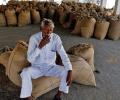
The sample size of 8,100 farmers across 19 states has not changed in the last three decades, and the methodology of the sample survey too remains unchanged

To tide over the difficulties due to incessant shutdowns, several farmers in Maharashtra have turned into aggregators and started selling their produce without the help of mandis or agents. They have started contracting with bulk consumers like hypermarkets and co-operative housing societies to sell their produce directly.
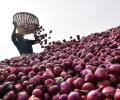
Data from the Nashik-based National Horticultural Research and Development Foundation showed that onion was trading at at Rs 24 a kg on Tuesday in the benchmark Lasalgaon mandi in Nashik district of Maharashtra. That's a fall of four per cent since Monday and 40 per cent from Rs 40 a kg on January 20, a level not seen since November 6, 2019. It continues to sell at Rs 40-44 a kg in retail markets across the country.

Retail prices of tomato had touched almost Rs 80 per kg in major cities owing to short supply and transportation cost over the past few weeks following heavy downpour.

Deficient rains in west, flooding in north play havoc with crop cycles.
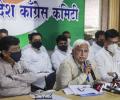
Deputy Chief Minister and NCP leader Ajit Pawar said farmers as well as the NCP and other parties are opposed to the new bills. "Farmers think that the laws are not beneficial for them. There was no hurry (to pass them)," he said.

The Maharashtra government on Thursday extended the lockdown-like restrictions in the state till June 1 to break the chain of COVID-19.

The petitions alleged that these laws would dismantle the Agricultural Produce Market Committee system intended to ensure fair prices for farm products

State Bank of India's house economists on Monday said the recent farm sector reforms reek of parochial thinking and promote lazy farming as they only cater to cereal-producing states. In the recently concluded monsoon session, the government rushed through three legislation to change the way agricultural produce is marketed, sold and stored by dismantling the decades-old APMC (Agricultural Produce Market Committee) mandis.

Apart from the human body, human food will bear direct repercussions. From staples such as wheat, to coffee, dairy, and even the great Hilsa face the threat of reduced supply due to the extreme heat.

Political parties, agriculture experts and progressive farmers demanded such agri reforms for long, he said and attacked the opposition for misleading cultivators on the issue of MSP (minimum support price) and APMCs.

Prices have continued to move up in Delhi's markets, wholesale and retail, on supply worries and spoilage due to record cold weather.

Barely days after imposing a 40 per cent export tax on onions to cool down soaring prices, which, in turn, triggered widespread protests across the main growing belts, the Centre on Tuesday sought to mitigate both political and economic tensions gripping parts of Maharashtra. It decided to procure an additional 200,000 tonnes of onions at Rs 2,410 per quintal for its buffer stock from farmers, a rate that is strikingly close to the price at which they were being exported before the 40 per cent duty was levied on August 19. The export price before the imposition of the duty stood at around $320 per tonne free on board (approximately Rs 2,650 per quintal).

The party said its government has taken a number of initiatives since its formation including tough action against hoarders and limiting export prices of essential commodities like onion, rice and wheat.

Ficci also said the new leadership is expected to recognise the industry concerns on land, labour and environment.
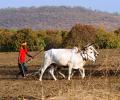
'We will be hoisting the tiranga, but this kind of celebration is uncalled for when the farmers in this country are dying by suicides, their families are ravaged by poverty and farmers are not enjoying any freedom.'

However, the farmers are still protesting, demanding a law on MSP. Besides MSP, the farmers are also demanding a resolution for the livelihood of the families of the 700 farmers who died while protesting against the three farm laws.

Data shows that the current system of decentralised marketing and centralised procurement helps Punjab and Haryana farmers the most, while its efficacy in other states has been poor. Experts and farm leaders say success of the laws rests heavily on implementation.

The day-long conference will be chaired by Finance Minister Arun Jaitely and presided over by both Food Minister Ram Vilas Paswan and Agriculture Minister Radha Mohan Singh.

'If a company contracts to buy its produce after three or four months, is there any loss in it?'

'There are legions of unemployed degree holders across rural and semi-urban belts in Maharashtra. Now, they aren't finding brides.' 'This issue has now snowballed into a social crisis. In 2014 and 2019, they had voted for the BJP.'

'The BJP alliance needs to handle the Maratha quota issue skilfully and address its root cause, which is agrarian distress. Then there is stalled industrialisation. If these issues are addressed, caste fault lines would wither away. But, this is next to impossible in a short span of three-four months.'
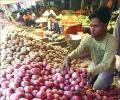
Retail prices across the country continued to be at Rs 80 a kg.
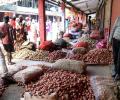
People in the know said plans were afoot to begin the sale of all food grains through online, with a major quantity through auctions that would be later extended to other commodities.
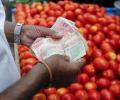
The agriculture ministry projects India's tomato output at 19.69 million tonnes in 2016-17 (July-June)

Farmers remained hesitant in sowing vegetable seeds in drought-hit areas.

Supply rises as farmers harvest crops amid fear of spoilage on expectations of early showers

Upset over the valuation, Sudhakar Darade returned home and threw 13 quintals of onion in his field.
